
How to Adjust Your Training When Missing Key Workouts.
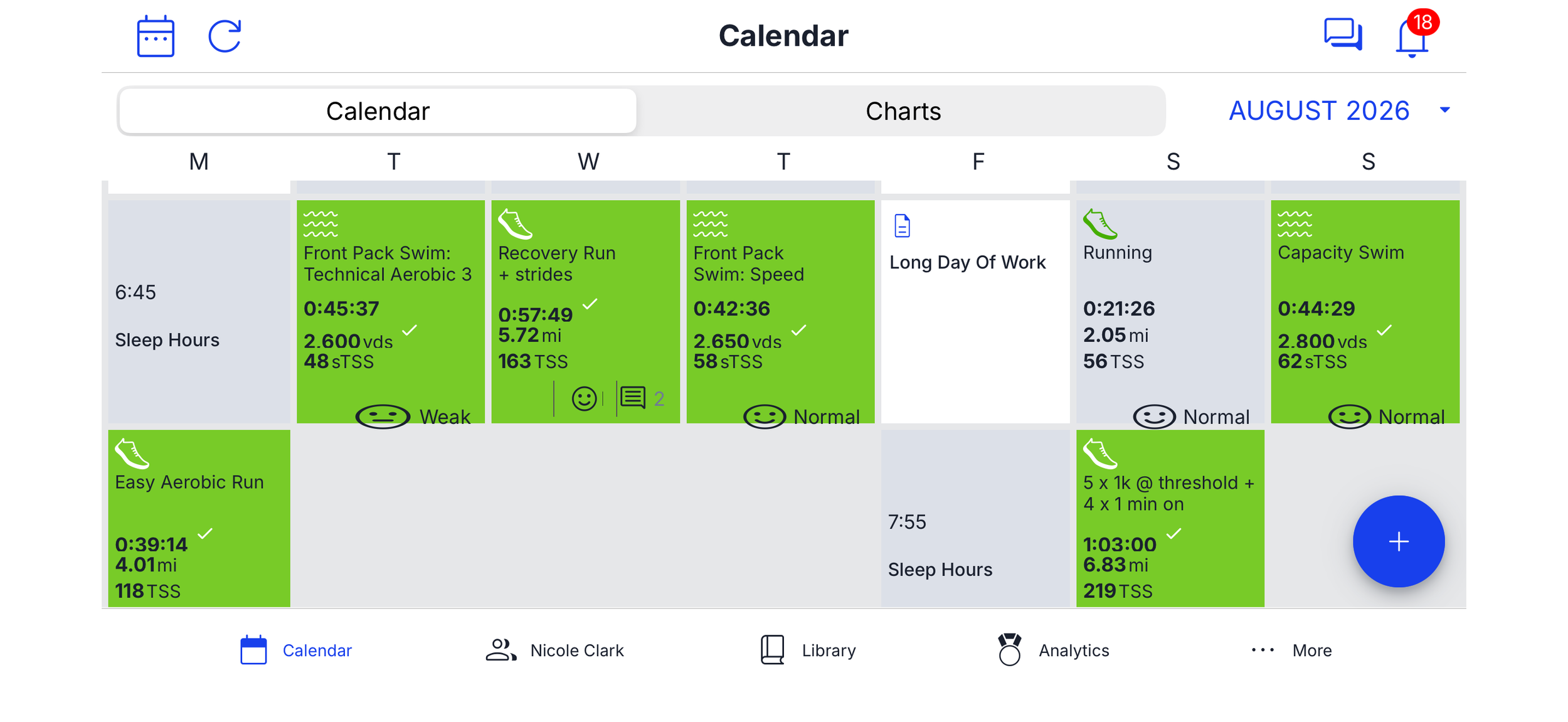
Not every week can be a flawless green. here’s how to navigate life.
flexibility & making changes to your training plan
Let’s be honest: your training plan is not happening in a vacuum with zerooooooo interruptions.
You most likely have a job, kids, family, weather extremes, travel, general life stressors, random ankle rolls on flat sidewalks.
okay that last one may have been just me…ha!
That doesn’t mean your training is totally doomed.
It means you need to know what actually matters, what you can move, and what you can let go.
A good training plan should give you structure without the experiencing panic every time life gets in the way. so below i’m addressing several common questions I get as a coach.
how much recovery do you need between hard workouts?
As a general rule, I want at least 1-2 easy days between quality sessions.
Quality sessions include:
intervals
tempo/threshold work
hills
fartlek
hard progression runs
races
Ideally, you’ll have two days between harder efforts, especially when the workouts are particularly demanding.
That doesn’t necessarily mean two complete rest days.
It can look like:
hard → easy → easy → hard
or
hard → easy → rest → hard
The goal is simple:
Keep your easy days easy so you can actually make your hard days hard.
Your fitness is built through the combination of stress + recovery.
More hard running isn’t automatically better running.
why can’t I just stack my hard workouts together?
Because your body doesn’t care that your calendar is inconvenient.
Back-to-back hard sessions can:
increase fatigue
compromise recovery
increase injury risk
make your next workout garbage
interfere with sleep and overall recovery
make it harder to absorb the training you’re actually doing
And here’s the thing:
You don’t get extra fitness points for being exhausted.
Sometimes the smartest training decision is moving a workout by 24 hours.
I swear you are NOT lazy. Pinky promise, cross my heart and hope to live lol
You will be training intelligently by pivoting.
what if I miss training because of illness, injury or life?
First: don’t panic. take a few deep breathes and zoom way way out.
Missing a few sessions does not erase months of training.
Here is what actually factors into your fitness:
how much training you missed
what you missed
why you missed it
how close you are to race day
how your body feels when you return
my general rule f thumb:
miss 1–3 quality sessions
→ resume your plan
You probably don’t need to reinvent your training because you missed a few workouts.
miss 4–8 quality sessions
→ revise your plan
This is where I’d start looking at:
your remaining training time
your current fitness
what workouts you’ve missed
whether your race goal is still realistic
whether certain sessions need to be removed or modified
miss 9+ quality sessions
→ reassess the goal
That doesn’t automatically mean you can’t race.
It may mean:
adjust your time goal
change from an A goal to a completion goal
defer the race
choose a later race
give yourself more time to rebuild
and one big exception:
If you were out because of injury or illness, the number of missed workouts isn’t the only consideration.
You need to make sure the reason you stopped training has actually been addressed before trying to jump back into the plan.
Ask yourself:
Am I actually recovered?
Is the pain gone—or am I just tolerating it?
Am I sleeping enough?
Have I been eating enough?
Did I ignore recovery?
Do I need new shoes?
Is there a strength or mobility issue I need to address?
Am I trying to make up for missed training?
Do not try to cram missed workouts into the calendar.
You cannot make up fitness by doubling down on fatigue.
coming back after a break
If you’ve missed three or more days of training, I don’t want your first run back to be an interval workout.
Start with:
easy running
1–2 easy days
shorter duration if needed
effort-based running rather than chasing pace
Then gradually return to quality.
And remember:
your first run back does not need to prove anything.
It is simply information.
How does your body feel?
How does your breathing feel?
How does your effort feel?
Use that information to decide what comes next.
what if the weather ruins my training week?
Welcome to being a runner. especially if you live in the extremes like summers in Florida or up north in winters of Michigan.
Sometimes it’s:
extreme heat
thunderstorms
high winds
snow
ice
humidity
whatever fresh nonsense the weather has decided to throw at you.
You have options.
first, ask:
Can I move the workout?
Maybe your normal Tuesday morning isn’t safe; but Tuesday evening is.
Maybe Wednesday is terrible but Thursday looks great.
Move it. If you’re a premium member on TrainingPeaks you can rearrange your own workouts. Or you can always reach out to your coach.
if you can’t move it:
Modify it.
You can:
run by effort instead of pace
shorten the workout
substitute an easy run
use the treadmill
cross-train
skip the workout
And yes:
missing one interval workout will not ruin your marathon.
The problem isn’t missing the occasional workout.
The problem is turning every missed workout into a crisis.
what if work or family gets in the way?
this one is simple:
FAMILY ALWAYS comes first.
If you know certain periods are going to be chaotic, plan around them.
For example:
major work deadlines
holidays
family events
vacations
kids’ activities
major life transitions
Your training plan should fit into your life; not require your entire life to revolve around it.
And sometimes the best decision is simply:
“I can’t get this run in today.”
Okay. Move on.
Don’t spend the next three days feeling guilty about it.
what if I want to change my training plan?
You can.
But don’t confuse more with better.
Before adding workouts, ask:
Why do I want to add this?
Does it serve my goal?
Am I recovering well?
Do I have a history of injury?
Am I adding it because I need it; or because I feel like I should be doing more?
If you’ve been training consistently, recovering well and staying healthy, adding an occasional easy run may be completely appropriate.
But adding more intensity just because you’re feeling ambitious?
That’s where I want you to pump the brakes.
do I really need to run 20+ miles before a marathon?
No. not always…
And this is one of the biggest places runners get caught up in checking boxes instead of building fitness.
You don’t need to prove that you can run 24 miles in training in order to run a marathon.
Long runs ARE important.
But they’re not the only thing that prepares you for 26.2.
Your preparation also comes from:
consistent weekly mileage
long runs
easy running
threshold work
marathon-specific work
hills
strength training
recovery
fueling
sleep
time on your feet
A long run that leaves you wrecked for five days isn’t necessarily more valuable than a slightly shorter run that you can actually recover from.
The goal isn’t to survive training.
The goal is to arrive at race day prepared.
what if I want to add races?
Absolutely.
I actually love races as part of a training cycle.
A race can be:
a fitness check
a hard workout
practice with race-day fueling
practice with pacing
a confidence builder
a fun break from the training grind
The key is knowing what role the race is playing.
For a shorter race, you can often replace a quality workout with the race.
For example:
5K or 10K
Saturday race:
race replaces a midweek quality session
easy running before the race
long run can often remain the following day if you’re accustomed to it
keep the following week flexible based on recovery
Sunday race:
race may replace the long run
don’t force another long run just because your plan says so
adjust the following week’s quality work based on how you recover
half marathon
A half marathon is a bigger training event.
If you’re racing it hard:
treat it like a major workout
don’t stack another hard session immediately around it
consider it your long run for the week
adjust the following few days based on recovery
And remember:
You don’t need to race every race.
Sometimes the smartest thing you can do is run it as a controlled effort and get the training benefit without turning it into an all-out PR attempt.
For most runners, I wouldn’t make a habit of racing hard every weekend during a marathon build.
Your A race is still the A race.
what if I want to train with a group?
Do it.
Running with other people is one of the best parts of the sport.
But there’s one catch:
The group workout isn’t automatically your workout.
Your training plan was built around:
your goal
your current fitness
your mileage
your recovery
your race distance
So if the group is doing 12 x 400m because that’s what everyone else is doing, that doesn’t mean you need to do 12 x 400m.
Use the group for:
motivation
accountability
community
fun
But make sure the actual workout still makes sense for you.
what if I don’t have enough time?
First:
something is better than nothing.
But don’t automatically assume every run can be cut in half without consequence.
Some sessions have a very specific purpose, especially:
long runs
marathon-specific workouts
threshold sessions
race simulations
If you genuinely don’t have the time, modify intelligently.
Get creative:
run during lunch
run commute
run while your kids are at practice
run before work
run after work
split an easy run when appropriate
But if the choice is between squeezing a stressful 30-minute run into an impossible day and getting the sleep you desperately need?
Sleep.
Recovery is training too.
what if I want to run more?
You might be able to.
If you’re healthy, recovering well and have a solid running background, an additional easy run can sometimes be a great addition.
But ask yourself why you’re adding it.
Are you adding mileage because:
it genuinely supports your goal?
you enjoy running more?
you want more aerobic development?
Or because:
Strava says you ran less than your friend?
you feel guilty?
you want to hit a nice round mileage number?
someone else is running 50 miles and you’re running 35?
Let’s be very clear:
Your Strava mileage is not your fitness score.
Running 49 miles instead of 50 doesn’t mean you failed.
And running 50 instead of 49 doesn’t magically make you fitter.
Don’t chase mileage just to chase mileage.
Maybe that extra hour would be better spent:
sleeping
strength training
eating
recovering
spending time with your family
doing literally anything that makes you a functioning human being
our number one rogue rule: don’t panic. pivot.
Your training plan is a roadmap.
It is not a set-in-stone contract.
You are allowed to:
move a workout
shorten a run
skip a session
change a pace
take an extra recovery day
race instead of workout
use a treadmill
adjust mileage
reassess your goal
What you don’t want to do is turn one missed workout into a week of bad decisions because you’re trying to “make up” for it.
You will become the best runner for yourself by executing the workouts with intelligent intention. Then adapt as you need. Because eventually, something will happen. It’s inevitable.
You will get sick.
Your kid will need you.
Work will explode.
It’ll be 95 degrees.
Your alarm won’t go off.
Your legs will feel like garbage.
Your aunt Susie will plan a 3-day weekend family reunion (okay hopefully not this…).
And when that happens, I don’t want you thinking:
“I ruined my training.”
I want you thinking:
“Okay. What’s the smartest move from here?”
That’s training.
Not perfection.
Consistency + adaptability.
And that’s how we get you to the start line ready to do the thing you decided you were crazy enough to do in the first place.
